
The day before Thanksgiving in 2009 I was invited to assist with the Nutty Putty Cave rescue of John Edward Jones. I ended up being the last person to see him alive, though at the time I arrived he was mostly unconscious. Since that time I have received numerous questions from reporters and curious individuals. Recently there has been an uptick in those requests as a result of some viral videos that have been posted. This is my attempt to provide information and help answer the questions that I am qualified to answer.
The day after the rescue efforts failed I wrote up a detailed account from my perspective of the rescue while it was fresh in my mind. Keep in mind that this is only one perspective from someone who arrived at the scene toward the end of the rescue efforts.
For a more well-rounded perspective I would encourage you to read Lindsay Whitehurst’s two-part Salt Lake Tribune article.
I will provide some commentary below my report with the footnote number indicated in report in parenthesis.
WARNING: This report contains descriptions of John Jone’s condition, passing, and post-mortem condition that could be disturbing to some readers. Out of respect for John and his family, I have tried to keep descriptions as general possible while addressing the challenges we were up against.
Nutty Putty Rescue Report
Written for SAR on November 25, 2009
I received the first call at 9:00 or 10:00 AM from Spencer Christian and Rodney Mulder that there was a rescue underway at Nutty Putty. They asked me if I could assist, but after asking a few questions about what was going on it seemed there were already enough people on site to carry out the rescue. I told Spencer and Rodney that if the rescue went on for a while and people started getting exhausted, and they absolutely needed me, that I would come.
About 5 hours later Spencer called me up and asked me to respond, saying that people were getting tired and they really needed small cavers. So I left work at about 4:00 PM, ran home to grab my caving gear and then headed out to Nutty Putty. I arrived at the site at about 6:00 PM and was put on the next group to go in the cave at about 6:30 PM.
When I arrived to the main passage at the opening of the Birth Canal people were working on the 4 to 1 haul system they had installed. I assisted for about 5 minutes, until it was decided that the system didn’t seem to be working (1) and the people by John Jones (the victim) needed a break. So the cavers that were working with John headed out.
On the way out I spoke with Andy Armstrong. I asked him how John was doing and he said that he was quickly going downhill, that he was in and out of consciousness and had started talking about seeing angels and demons around him.
As soon as they were out, we decided that I would head in first to assess the situation and see if I had any ideas for removing him, and then Debbie would work with John, since she had already spent some time with him getting to know him and she thought he would feel more comfortable with her.
So I went in first. In the back of the passage, right before you arrive at where John now is, there is an extremely tight crawl perhaps 18 inches wide and about 8 to 10 inches tall that takes a sharp 90 to 120 degree turn that you have to enter feet first. You have to maneuver yourself very carefully and you cannot see where your feet are standing until you pass the restriction. As I wormed my way in I felt my feet touch something soft which ended up being John’s feet. I felt them move and immediately lifted my feet and worked my way horizontally into the crack.
John’s feet were about 6 feet past the constriction and I was able to shift myself to the side of him and down the 4 foot wide fissure. After stabilizing myself by jamming my body into a narrower section of the crack I began speaking to John asking him how he was and introducing myself. There was no response. I shifted my position a little and tapped him on the leg. I could hear him breathing a deep gurgling breath, as though his lungs were filling with fluid. Then his feet shifted as though he were trying to maneuver his legs out of the crack he was jammed in. The kicking looked fairly frantic and after a second he stopped and it looked as though he had drifted into unconsciousness. (2) I continued tapping him on the legs and hip to see if I could get a response, but there was no response.
From there I spent a few minutes studying the passage, the positioning of John, and the rig that was set up, to see how we could get him out from here. It looked very bleak. I wondered if it was even possible to get him beyond this point. We could continue trying the rig, but it looked like he could only be lifted another foot or two in his current position because of where the webbing was anchored around his knees. After a foot or two his feet would hit the ceiling. And then once he reached the ceiling, there was no way to tilt him to a horizontal position. He would have to do it himself, but he was now unconscious. And even if we could get him into a horizontal position, he would then have to maneuver the most difficult sections of the passage he was trapped in. If he were conscious and had his full strength there was a minute chance he could possibly do it. But even if that was the case it looked grim. It was even difficult for me, weighing 125 pounds, to get myself out. At the bend where the restriction was I had to creatively contort my body to slip through. So to get a 210 pound, unconscious person out seemed pretty much impossible. The other option I saw was to use a jack hammer to widen the crack he was and remove a couple of knobs and then widen the tight spot, and then pull him straight out. He would be cut up very badly and probably end up with several broken bones, but if nothing else would work, that seemed like the best option.
Between me climbing out and Debbie taking my place there was a request to take the radio down to John so that his family could say some words to him. I think it was his father, mother, and wife who spoke to him, telling him that they loved him and were praying for him and that his father had given him a blessing. His wife mentioned a feeling of peace, that everything would be OK. She talked to him about 5 to 10 minutes before I told her that we needed to get back to working at getting him out.
At that point I crawled out to let Debbie squeeze past and take a look and assess the situation, but when she got to the tight hole, both legs cramped up and she was unable to make it down. At that point I decided to try using the jack hammer. So we waited for it to arrive and then I carried it down to where John was located. The tool was much heavier than I anticipated and to hold it up while wedging my body in the crack took everything I had. Even then, I couldn’t get a good angle on the rock because of the confined space and limitations in my own mobility and positioning. I only got three tries at a small lip just below Johns foot, but because of my angle the hammer just kept sinking into the sand at the side of the rock lip. I tried shifting my position, but it seemed like everywhere else I moved I couldn’t get a handle on the jack hammer because of it’s length. I only had about 2.5 feet of space between me and the rock that needed drilled and the jack hammer was probably 3 to 4 feet long. And then trying to hold it in such an awkward position wore me out pretty quick.
At that point I requested something smaller, but there didn’t seem to be anything available, and even if there had been I don’t know if a small hammer drill would have done much against the solid limestone walls. So we returned to the Birth Canal to have a quick meeting to decide what to do.
At that point it sounded like the drills were having issues or something like that, and the only option we had for drilling was to use the compressed air hammer. It took probably an hour or so to get hose down so we could use it. While we waited, we decided that perhaps the best bet was to try widening the hole from the top down, working our way towards John instead of away from him. Once the drill arrived Debbie, Max, and I spent about an hour and a half chipping at the passage a couple of feet above the tight spot – about 7 to 9 feet away from John. Areas where the rock was softer came apart fairly easy, but the harder formations took an incredible amount of effort. The main problem was that because space was so limited it was difficult to hit the rock at the right angle, so instead of chipping off the knob you would end up cutting a hole straight into the floor.
After an hour and a half we had only knocked off about a 18” x 4” section of rock on the ceiling and on the ground. And that was at the wider section of the passage. From that point on the cave was even tighter so that if you were laying in the passage and weighed 125 pounds you only had about 3 to 6 inches of space above you. Not very ideal for holding a jack hammer or even being able to choose the most effective angle. To continue the process, or even if we switched to micro-blasters, my estimate was anywhere from 3 to 7 days to get back to where John was. So once again we regrouped to decide what the next plan of action was.
By now it was close to midnight and we were asked to check vitals on John. They sent in a smaller paramedic to see if he could get back to John. In the event he couldn’t he showed me how to use the stethoscope and thermometer and where to check for a pulse. It was 11:30 PM when we left the group by the birth canal and ventured down the passage. It took about 15 minutes to get to John. I went first to check, just in case the paramedic couldn’t fit. I first tried the stethoscope and was only able to get it about 3 inches up and to the right of his naval. I didn’t hear a distinct heart beat, only some ruffling, fluttering sounds that were probably a result of me shaking as I tried to steady myself in an awkward location. I then jammed my hand between the rock and pressed as far up his torso I could go to feel for breathing. I didn’t think I felt anything, but again it was difficult to tell as I was shaking from trying to steady myself. His chest, where it was pressed up against the rock, felt warmer than the rest of his body and was sweaty, but every where else his body temperature was close to the temperature of the rock on the cave walls. From there I removed his shoe and attempted to check his temperature. The thermometer read nothing, which the paramedic said was because the temperature was below the range. As I took his shoes off and moved his feet I noticed that his feet and legs were significantly stiffer than they had been earlier and it was difficult to his leg more than a few inches.
I reported my findings to the paramedic above and then crawled out so that he could see if he could squeeze in. He was able to get dow to the point where he could feel his feet and confirm he had passed away. John Edward Jones was pronounced dead at 11:52, I believe it was.
At that point we decided to return topside for a debrief to discuss what our next plan of action would be. As everyone headed out, the paramedic and I went back in to take pictures of the passage and John’s position.
With John now deceased the effort required to remove his body would be exponentially more challenging. His stiffening body wouldn’t be able to make the bend through the tight spot above his feet, without significant alterations to the passage, which could take days or weeks with a hammer drill, perhaps slightly faster with micro-blasters. Any swelling would make it next to impossible to get him out of the crack he was wedged in until the swelling had reduced. There was no way to connect him to a rope other than by his feet. After a few days, we would need a hazmat suit and masks to work with the body, which would severely overheat any rescuers trying to get him out. With pants and a short sleeve shirt a person is usually dripping with sweat in about 10 to 15 minutes and can work for about 30 to an hour before needing a break. With a hazmat suit and mask you could probably work for 5-10 minutes before needing a break, not to mention the limit to your mobility. The body recovery idea looks very grim. (3)
Photos from the Rescue
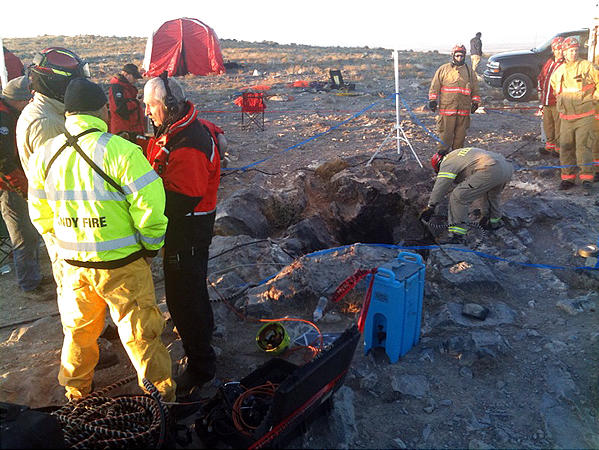

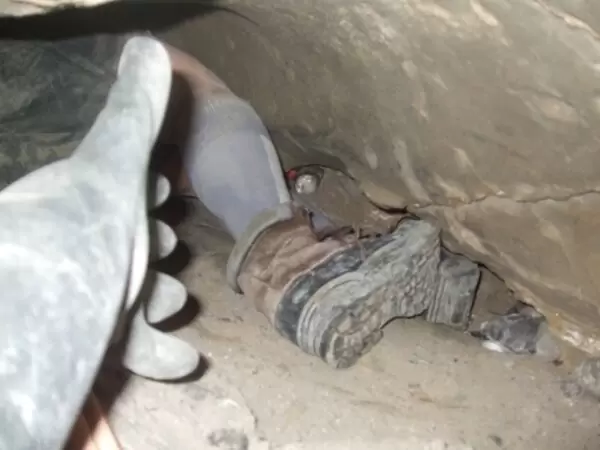
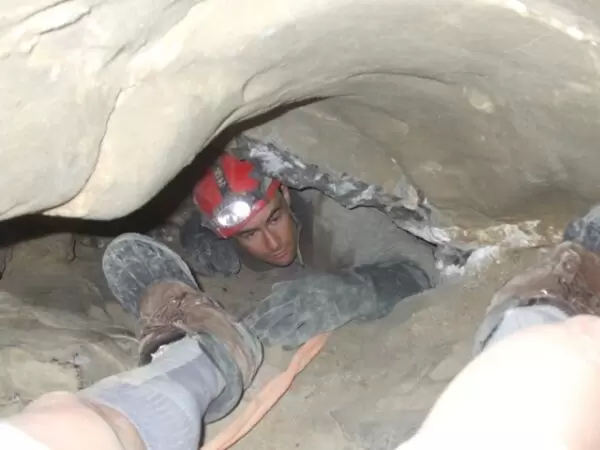
NOTES
- The 4 to 1 haul didn’t work because there were so many twists and turns in the cave between where there was room for a group to stand and haul and John’s position that the friction, even with pulleys in place was enough to render the haul system ineffective.
- This was the moment he passed away.
- Ultimately it was decided it would be too risky to rescuers to attempt to remove the body, and to this day Nutty Putty Cave is the final resting place of John Jones.
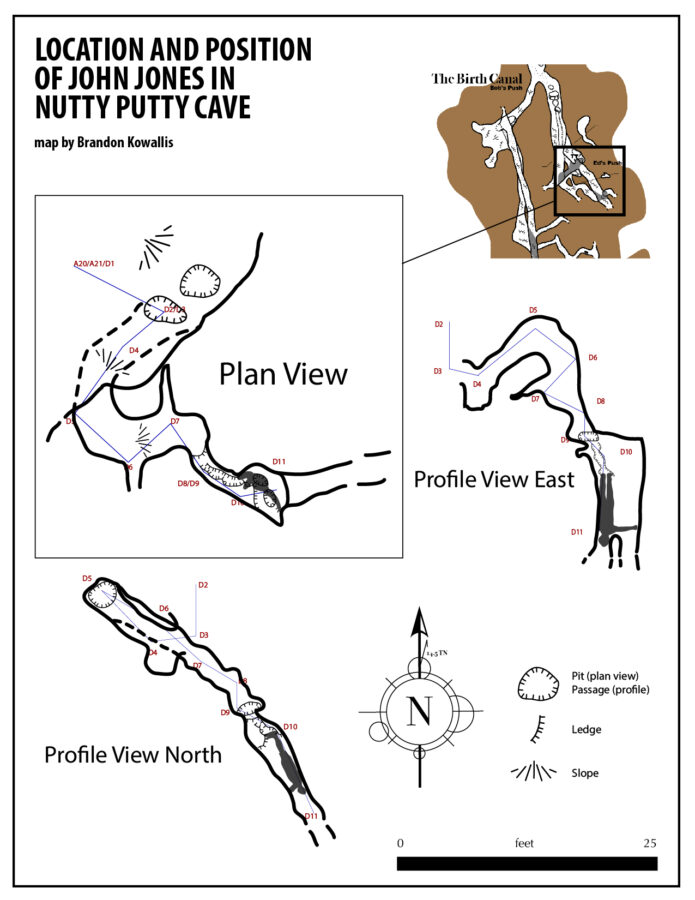
RESOURCES
VIDEOS
COMMENTS
Comment about Comments Below
I really appreciate everyone’s kind and encouraging words in the comments below, as well as your questions. Unfortunately, I no longer have time to respond to questions and comments. I will continue to approve the comments you post as long as they are family friendly, but just know that I only log in to approve comments every few weeks.
Thanks again for your kind words!
Greetings Brandon! 👋
Thank you for taking your time to answer all these questions! 🙏
I know it’s been years now since the incident but was it really impossible to get John out? Even if he got out he would have died? Just curious.
How did you feel after he died?
Do you still visit the Nutty Putty Cave after the incident?
Those are all my questions. Thank you Brandon and I hope you have a wonderful day! God bless you 🕊️🖤🤞💯
Yeah, there is a lot I don’t know either regarding what happened before I got there, so unfortunately I don’t have any insights on your first question. For your second question I would say he slithered into the crevice where he was stuck.
1. Given the circumstances yes. If we had managed to get him out early he would have been fine.
2. I think we were all incredulous and had a hard time wrapping our mind around what had happened.
3. Not really. It’s sealed shut and a long drive over really nasty roads to get out there.
Hey Brandon,
After reading through most Nutty Putty literature, I still have one question: Do you think John intentionally entered Ed’s push? I’ve seen some say that, due to a lack of wear/dust on the entrance to Ed’s Push compared to the Birth Canal, it would have been plainly obvious where one was supposed to go. With all due respect to John, I think achieving the most factual account of what happened is important.
Thank you.
Hi Brandon, I have three questions:
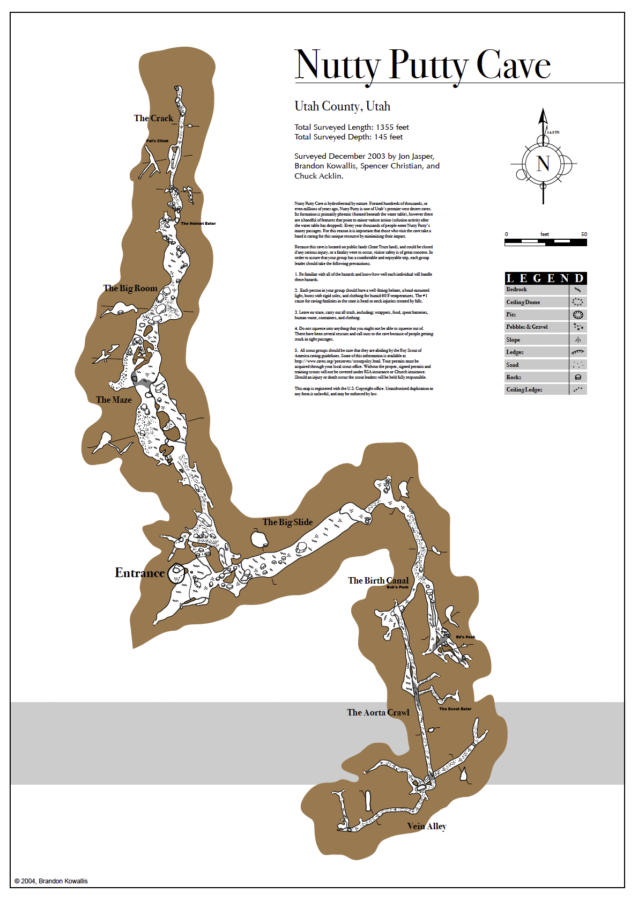
1) In the section a few feet before where John was trapped (the area where the rescuers could touch his feet and tie the rope to him), what was the slope? I’ve seen some diagrams depicting it as flat, whereas other maps show it as slanting downhill. If it was flat then I’m not sure the rumor of John accidentally falling into the hole would make sense.
2) Historically, how would people turn around after the corkscrew? Based on diagrams it seems like there isn’t any room to turn your body around, and from my understanding the reason Brock Clark got trapped in 2004 was because he tried to turn around after the corkscrew and got stuck.
3) From what I’ve read, prior to 2009 it seems like the most serious rescue was Brock Clark (unlike the other rescues he was upside down and trapped for far longer), I know that his rescue sparked debate on restricting access to the cave, but were there ever any discussions on just closing off Ed’s Push specifically? Since that’s where Brock was stuck and was considered a dangerous passage.
Thank you
You are resilient. Admirable. How are you still able to answer as if it were yesterday that it all happened? I think loads of us could have PTSD just after learning about this event. I can’t imagine about your mental health, you, having been at that tragic site throughout. Does the re-telling, talking about it over and over help? Kindly share tips of psychologically surviving such a traumatic event.
Hi Brandon. This has been eye opening. The tragedy really affected me! Like many others. Thanks for your responses.
I want to ask 2 things please.
1. In the narrow passage he was squeezing through, just before he went into the downward crevice, is there any way to go backwards? If a caver suddenly realises they don’t want to continue, can they not go backwards in a tight space rather than find an opening? Or was it too awkward to navigate backwards?
2. I simply cannot understand why 2 people can fit in a crevice but one person can’t wriggle out or un-wedge themselves and why the second person (the rescuer) isn’t able to push the stuck person up if they are able to be by their side. I get it isn’t possible probably due to the type of space it was. But my mind can’t compute it. Surely, if a crack was so tight – no one could get access to any part of that, let alone be standing next to the stuck person. Is that my understanding? That a rescuer was able to stand in the same crevice but not help in lifting or moving John out?
Thank you so much
Hi Brandon,
Thanks so much for sharing all this. I read the entire blog and your comments.
I first realized I was claustrophobic while exploring a cave for the first time. It was a simple one, with expert cavers guiding us, but there was one narrow passage that triggered a deep panic. That moment stuck with me, and I’ve had a serious fear of tight spaces ever since. Maybe that’s why this incident hit me even harder.
But I’m grateful to you for laying out the full picture, it made the whole thing more understandable and less terrifying.
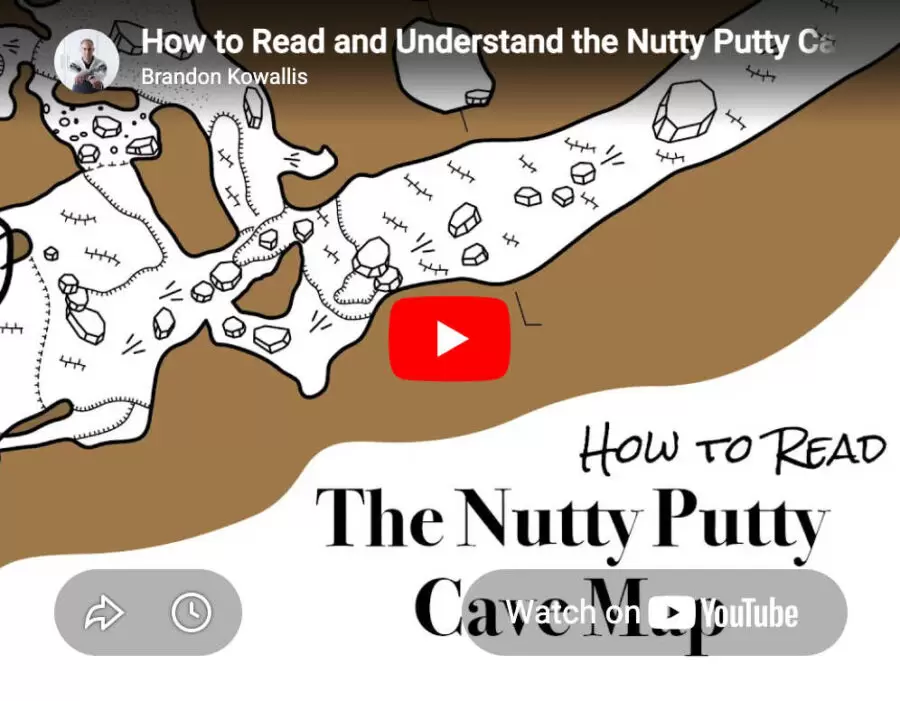
Seeing the maps and reading how each rescuer went in feet first, and that two people could fit in there (even if barely), helped me actually visualize it. I could begin to grasp what it felt like in real terms. This is getting long, but I did have a few questions I haven’t seen answered. Not sure if you’ll see this, but in case you do-
1. I zoomed into the 2004 cave map you shared. It looked to me like Scout Eater was even narrower than Ed’s Push—at least visually. I am not surprised that it took 14 hours to rescue the teen. Am I right to think Scout Eater was even more difficult and narrower?
(Also, from the fork between Birth Canal and Ed’s Push, the Ed’s Push path looks wider—like someone with John’s build would naturally drift that way. Just feels like pure bad luck he got stuck there. That slightly wider path also makes me wonder if others ever got briefly stuck but managed to get out.)
2. I hope I’m not jinxing anything by asking, but have you ever been stuck in a cave?
3. From what I understand, the rescue plan involved rotating him, either 180° onto his back or 90° to the right, so he could push himself out using his hands and back. Is that correct? And you felt this had to be done fast, within 3–4 hours?
4. Before the pulley broke, had they managed to rotate him even a little? Or did it snap before any repositioning happened? From the article you linked, Ryan could slightly bend and show his face to John. That makes me think they had moved him somewhat. Just wondering if there was any shift at all before things went wrong.
Thank you for all the effort you’ve put into this, writing the article, sharing maps and images, and answering so many detailed comments. You may not realise it, but it’s helped a lot, not just me I am sure, but many others. I’m genuinely grateful for the clarity and perspective you brought to it.
[Re-sending the comment because of the poor formatting]
Hi Brandon,
Thanks so much for sharing all this. I read the entire blog and your comments.
I first realized I was claustrophobic while exploring a cave for the first time. It was a simple one, with expert cavers guiding us, but there was one narrow passage that triggered a deep panic. That moment stuck with me, and I’ve had a serious fear of tight spaces ever since. Maybe that’s why this incident hit me even harder. But I’m grateful to you for laying out the full picture, it made the whole thing more understandable and less terrifying.
Seeing the maps and reading how each rescuer went in feet first, and that two people could fit in there (even if barely), helped me actually visualize it. I could begin to grasp what it felt like in real terms. This is getting long, but I did have a few questions I haven’t seen answered. Not sure if you’ll see this, but in case you do-
1. I zoomed into the 2004 cave map you shared. It looked to me like Scout Eater was even narrower than Ed’s Push—at least visually. I am not surprised that it took 14 hours to rescue the teen. Am I right to think Scout Eater was even more difficult and narrower?
(Also, from the fork between Birth Canal and Ed’s Push, the Ed’s Push path looks wider—like someone with John’s build would naturally drift that way. Just feels like pure bad luck he got stuck there. That slightly wider path also makes me wonder if others ever got briefly stuck but managed to get out.)
2. I hope I’m not jinxing anything by asking, but have you ever been stuck in a cave?
3. From what I understand, the rescue plan involved rotating him, either 180° onto his back or 90° to the right, so he could push himself out using his hands and back. Is that correct? And you felt this had to be done fast, within 3–4 hours?
4. Before the pulley broke, had they managed to rotate him even a little? Or did it snap before any repositioning happened? From the article you linked, Ryan could slightly bend and show his face to John. That makes me think they had moved him somewhat. Just wondering if there was any shift at all before things went wrong.
Thank you for all the effort you’ve put into this, writing the article, sharing maps and images, and answering so many detailed comments. You may not realise it, but it’s helped a lot, not just me I am sure, but many others. I’m genuinely grateful for the clarity and perspective you brought to it.
Hey Brandon, I’ve been fascinated about this case for years and I’m so happy I found this blog. It’s hard to wrap your head around how tight the spaces were and the hole John found himself in even with the diagrams, but you’ve given me a much better idea. Your explanation on what happened, the positioning of you and the other rescuers and John is probably the best I’ve seen. You guys did an amazing job given the circumstances and took quite a bit of risk while doing so. It’s really remarkable how tight this passage was. Even before your observations I came to the conclusion that once he got stuck there, there was no saving John. Your writings have basically confirmed it for me. It would have required an almost immediate reaction and an insane amount of effort from John himself to even get so far as the ceiling and turn himself around so his legs could bend properly that I don’t see myself how it would have happened even with him at 100%. Even if the pulley system worked perfectly, the rescue effort seemed doomed from the get go. And trying to drill to get to him would have taken so much more time than what he had even if said drilling started from the moment he got stuck. You guys truly did everything humanly possible.
At any rate, I have one question. In the 3rd photo of you and the paramedic, the one in which you have your thumb up raised to show how tight the passage was and the paramedic’s feet ahead of you, there are a pair of boots in a narrow hole right next to the medic’s. Are those supposed to be John’s feet?
Either he was confused and thought he was in the Birth Canal or he intentionally decided to explore the Ed’s Push area. Those are my two guesses.
It was flat for maybe a foot and then there was maybe a 45 degree slope.
Contortion skills, it’s not easy.
Not that I know of.
I made quite a few trips to Nutty Putty before it was closed.
It’s been so long it doesn’t really bother me anymore. I’ve always been pretty good at bouncing back from traumatic situations like that. I think it’s just different for everyone.
It would definitely be hard to back out. For your second question you would have to be there to understand. It’s impossible to describe.
1. About the same.
2. No.
3. Correct.
4.I wasn’t there when that happened so I can’t say.
No. They are the rescuers. Cave photos can be very disorienting.
Thank you so much for all the information, Brandon. I won’t repeat any questions above. My simple question is how you think he bent his legs enough to go down into the fissure, when it was impossible to bend them on the way out?
Hi just want clarification.
You said at 2) his feet moved franticaly this was the moment he passed away.
However later down the passage his family spoke to him.
So.his family spoke to him.after he passed away…
Hey there Brandon,
Had a suggested movie which was John’s on Roku I think. Watched that and then found some YouTube videos and eventually your site here. This has really blown my mind. I’m not one that thinks crawling into caves would be fun and I’ve said numerous times over the past week how I can’t get over John crawling in there on purpose. And still being there to this day Then I see your comment section and find that I’m by far not the only one who can get this off my mind.
We know from the movie he did panic and flail a bit then you said he kicked and failed. How did you and the folks before keep him calm? I have a high level of anxiety just watching it so I can’t imagine. Also, what do you think doing this caving that people find attractive? What about it do you find attractive?
I am glad there are people such as yourself to come and help others. You risk your own life and that is no small thing. Please be so careful and vigilant when you do this. And no those or us out here appreciate you too. I am sorry for the loss of John. We know where he is though for sure which is in heaven with His Father.
Amazing story Brandon. I am an avalanche survivor (of an alpine climb on Mt. Baker, WA in 1986), where 2 of our party of 4 were killed, buried in a crevasse under tons of ice and snow, yet found together a month later by 2 Austrians who peered down the crevasse, which had now opened wider because of the continuing high summer heat. They saw what appeared to be an arm that had thawed out of the ice. The initial search having been abandoned two days after the avalanche.
I want to say thank you Brandon. You are Heroic, along with the others, for your risk of your own safety to save a comrade in need. For me, though the Forces of Nature, and I believe with the Providence of God, carried me over that crevasse (which was critical In my survival) I could not have survived without the heroism of the many rescuers who put themselves in personal danger to save us, me and my friend Kurt, who miraculously survived his 75-foot fall into that same crevasse. This also includes The bravery of the men and women that probed the ice for 2 1/2 days, searching for the two bodies. Small avalanches and rock falls continued over the next two days. Fortunately, the wall of ice that collapsed on us shot the bulk of the glacier’s bolt, which was the real impending threat, and the bulk of the ice that was the most exposed that weekend. That’s the reason there was no other large slide during the continuing search effort, fortunately.
We suffered from severe hypothermia, where my body reached a low of 92 degrees, bordering on fatal cold. Largely, it was because I lay in ice up to my chest for 20 to 30 minutes until rescuers got to me. Two sections of rope, one between me and the guide, and the other between me and my friend Steve, who is killed we’re very tightly wrapped one around each end of my ice axe, So tight in fact that the rescuers had to cut through the ropes to free me. Kurt was able to move more and generate heat and eat food so his temperature did not reach that low. However, we both were placed in sleeping bags with a couple of rescuers who shared their body warmth to help stabilize our temperatures. Once the Sun arose, this helped out tremendously!
However , we still lay about 3 1/2 to 4 hours waiting for a naval helicopter to lift us off the Mountain. Our helicopter pilot has his own heroine story to tell! He actually was awarded a special plaque by the Sikorski Corporation, for his bravery in the risky use of a Sikorski airship executing such a harrowing rescue mission. At that time the highest in elevation he had ever flown, 8800 feet.
Well, now about caving and spelunking, fast forward about a year and a half after the avalanche, I was in southern Idaho going to college. So, playing ping pong with two of my new college friends, who had the great idea (not really haha) of visiting “Kuna Caves”, south of Boise. My two friends were probably five or six inches shorter than me and weighed a good third of my body weight less than me. I was about 210. But lust for hubris consumed us as we were young and full of piss and vinegar, so we had to go see and experience the “lava tubes” down there in the caves. So, my pals both had already been down there and knew they could fit pretty easy. They weren’t thinking about me! But, I followed them in anyway.
This is where I have a great respect for confined spaces, which i learned more about much later in an SAR program. So, one of those tight holes that you all went in, were proportionally very much like the size of the holes we went in. One thing we had in our favor somewhat in the lava tubes, were little light pumice rocks! We actually crept in there much like you, sometimes with one arm pointed back and one arm forward, both arms forward, and at times both arms projecting backwards at our sides, similar to the strokeless motion of the legendary mermaid. Well, in several of the situations down there that day, we had to also push with our toes against the pumice stones behind us, which “rolled” and acted somewhat like marbles, to slowly inch our way forward. My buddies were able to go quite deep into the caves, and beckoned me so. However, because of my larger size and height, there was one place where we had to sit up in order to the negotiate another smaller hole to proceed to my friends. However, I could not sit up because of my longer legs and torso. I also noticed some old, rickety shoring timbers down there, which caused me to be more than a little nervous of potential collapse! So needless to say, with sheer fear of getting stuck if I went any further, I forced my body to turn around in that tight, shored-up intersection, to get as quickly out of there as I could! I think my toes were pretty sore after I exited the last lava tube!
Well needless to say, I emerged somewhat stressed, but relieved asi waited for my friends
I did not go back, and never will.
So, after seeing the story of John Edward Jones in “The Last Descent”, one thing I can relate to is the feeling of utter helpelessness, but at the same time, his tragic – heroic – yet futile efforts to save himself and return to his lovely little family. Another thing is being in a tight space where you cannot move out of life’s hard reality, without the help and hope in blessed others.
In Memoriam, I offer the following words, brief poem, of Reverence and Reflection to John’s Family, if you so choose to share with them. I wrote them in light of some similar circumstances and mutual kinship with Nature, we share.
May his legacy in his children keep his flame in their future alive.
– Earth and Ice –
He was trapped in rock
I, wrapped in ice
Alone, Alive, in Hope, we lay bare
Borne again, of rare device!
*****
I believe we die, only to live again, so perhaps it’s no coincidence that I reference this Scripture, my favorite, which is interestingly out of the “Book of John.”
John 11:25
God Bless John’s Memory, his Family, and to You Brandon, and Your Brothers and Sisters of SAR.
– Tom Waller, Jr.
Former SAR Member (WSDOT) and Climber
Grapeview, Washington State
Survivor of “Komo Kulshan Screamin'”, 3 August, 1986, Mt. Baker, WA
Hi Brandon, I really like caving, but what happened is horrible. I hope you’ve put it behind you. You did what was humanly necessary to get Giannis out of there. I would like to ask if you know if there is a different entrance to Natty Patty, as there may still be, in addition to Giannis’ remains, the remains of Susan Powell, and some may have wanted to close it permanently after his death to hide evidence. Her husband was found to have a postcard in digital form, which he described as a hole in the ground with a labyrinth.
Hi Brandon,
Thank you so much for taking the time to share your experience and insight. Your perspective helped clarify so many things that have stayed in people’s minds for years. I believe one of the main reasons this case still resonates so deeply is because we all put ourselves in John’s place—we think of his family, and we imagine the pain and helplessness he must have felt in that position. It’s heartbreaking, and your words bring clarity with great respect. Thank you again.
Randomly came across this but thank you for sharing! I’m an avid mountaineer (hiker, climber, biker) but very ignorant myself about safety. Stories and situations like these serve as a reminder that nature may be beautiful but is also deadly.
Great post! The information was clear, useful, and thoughtfully shared. Looking forward to more content like this.
I Brandon! Im Frank nice to meet you, this post its extremely interesting as it sheds light on many questions that arise when one first hears about the Nutty Putty cave incident, reading this I came to realize that maybe some kind of paint in circles at the “right” path in a cave could be very useful, make it so at the entrance of a cave you could see some signs or something alike to warn people that only passages with the paint at the entrance are explored and safe, so that it they dont see the paint they dont enter or turn back before something bad happens and use diferent kind of paints for diferent passages; I dont know a thing about caving but I know that safety its always priority. I hope that I wrote this right as Spanish is my mother languaje and I almost never write in english, thank you for your time and your knowledge Brandon, be safe and well!!