
The day before Thanksgiving in 2009 I was invited to assist with the Nutty Putty Cave rescue of John Edward Jones. I ended up being the last person to see him alive, though at the time I arrived he was mostly unconscious. Since that time I have received numerous questions from reporters and curious individuals. Recently there has been an uptick in those requests as a result of some viral videos that have been posted. This is my attempt to provide information and help answer the questions that I am qualified to answer.
The day after the rescue efforts failed I wrote up a detailed account from my perspective of the rescue while it was fresh in my mind. Keep in mind that this is only one perspective from someone who arrived at the scene toward the end of the rescue efforts.
For a more well-rounded perspective I would encourage you to read Lindsay Whitehurst’s two-part Salt Lake Tribune article.
I will provide some commentary below my report with the footnote number indicated in report in parenthesis.
WARNING: This report contains descriptions of John Jone’s condition, passing, and post-mortem condition that could be disturbing to some readers. Out of respect for John and his family, I have tried to keep descriptions as general possible while addressing the challenges we were up against.
Nutty Putty Rescue Report
Written for SAR on November 25, 2009
I received the first call at 9:00 or 10:00 AM from Spencer Christian and Rodney Mulder that there was a rescue underway at Nutty Putty. They asked me if I could assist, but after asking a few questions about what was going on it seemed there were already enough people on site to carry out the rescue. I told Spencer and Rodney that if the rescue went on for a while and people started getting exhausted, and they absolutely needed me, that I would come.
About 5 hours later Spencer called me up and asked me to respond, saying that people were getting tired and they really needed small cavers. So I left work at about 4:00 PM, ran home to grab my caving gear and then headed out to Nutty Putty. I arrived at the site at about 6:00 PM and was put on the next group to go in the cave at about 6:30 PM.
When I arrived to the main passage at the opening of the Birth Canal people were working on the 4 to 1 haul system they had installed. I assisted for about 5 minutes, until it was decided that the system didn’t seem to be working (1) and the people by John Jones (the victim) needed a break. So the cavers that were working with John headed out.
On the way out I spoke with Andy Armstrong. I asked him how John was doing and he said that he was quickly going downhill, that he was in and out of consciousness and had started talking about seeing angels and demons around him.
As soon as they were out, we decided that I would head in first to assess the situation and see if I had any ideas for removing him, and then Debbie would work with John, since she had already spent some time with him getting to know him and she thought he would feel more comfortable with her.
So I went in first. In the back of the passage, right before you arrive at where John now is, there is an extremely tight crawl perhaps 18 inches wide and about 8 to 10 inches tall that takes a sharp 90 to 120 degree turn that you have to enter feet first. You have to maneuver yourself very carefully and you cannot see where your feet are standing until you pass the restriction. As I wormed my way in I felt my feet touch something soft which ended up being John’s feet. I felt them move and immediately lifted my feet and worked my way horizontally into the crack.
John’s feet were about 6 feet past the constriction and I was able to shift myself to the side of him and down the 4 foot wide fissure. After stabilizing myself by jamming my body into a narrower section of the crack I began speaking to John asking him how he was and introducing myself. There was no response. I shifted my position a little and tapped him on the leg. I could hear him breathing a deep gurgling breath, as though his lungs were filling with fluid. Then his feet shifted as though he were trying to maneuver his legs out of the crack he was jammed in. The kicking looked fairly frantic and after a second he stopped and it looked as though he had drifted into unconsciousness. (2) I continued tapping him on the legs and hip to see if I could get a response, but there was no response.
From there I spent a few minutes studying the passage, the positioning of John, and the rig that was set up, to see how we could get him out from here. It looked very bleak. I wondered if it was even possible to get him beyond this point. We could continue trying the rig, but it looked like he could only be lifted another foot or two in his current position because of where the webbing was anchored around his knees. After a foot or two his feet would hit the ceiling. And then once he reached the ceiling, there was no way to tilt him to a horizontal position. He would have to do it himself, but he was now unconscious. And even if we could get him into a horizontal position, he would then have to maneuver the most difficult sections of the passage he was trapped in. If he were conscious and had his full strength there was a minute chance he could possibly do it. But even if that was the case it looked grim. It was even difficult for me, weighing 125 pounds, to get myself out. At the bend where the restriction was I had to creatively contort my body to slip through. So to get a 210 pound, unconscious person out seemed pretty much impossible. The other option I saw was to use a jack hammer to widen the crack he was and remove a couple of knobs and then widen the tight spot, and then pull him straight out. He would be cut up very badly and probably end up with several broken bones, but if nothing else would work, that seemed like the best option.
Between me climbing out and Debbie taking my place there was a request to take the radio down to John so that his family could say some words to him. I think it was his father, mother, and wife who spoke to him, telling him that they loved him and were praying for him and that his father had given him a blessing. His wife mentioned a feeling of peace, that everything would be OK. She talked to him about 5 to 10 minutes before I told her that we needed to get back to working at getting him out.
At that point I crawled out to let Debbie squeeze past and take a look and assess the situation, but when she got to the tight hole, both legs cramped up and she was unable to make it down. At that point I decided to try using the jack hammer. So we waited for it to arrive and then I carried it down to where John was located. The tool was much heavier than I anticipated and to hold it up while wedging my body in the crack took everything I had. Even then, I couldn’t get a good angle on the rock because of the confined space and limitations in my own mobility and positioning. I only got three tries at a small lip just below Johns foot, but because of my angle the hammer just kept sinking into the sand at the side of the rock lip. I tried shifting my position, but it seemed like everywhere else I moved I couldn’t get a handle on the jack hammer because of it’s length. I only had about 2.5 feet of space between me and the rock that needed drilled and the jack hammer was probably 3 to 4 feet long. And then trying to hold it in such an awkward position wore me out pretty quick.
At that point I requested something smaller, but there didn’t seem to be anything available, and even if there had been I don’t know if a small hammer drill would have done much against the solid limestone walls. So we returned to the Birth Canal to have a quick meeting to decide what to do.
At that point it sounded like the drills were having issues or something like that, and the only option we had for drilling was to use the compressed air hammer. It took probably an hour or so to get hose down so we could use it. While we waited, we decided that perhaps the best bet was to try widening the hole from the top down, working our way towards John instead of away from him. Once the drill arrived Debbie, Max, and I spent about an hour and a half chipping at the passage a couple of feet above the tight spot – about 7 to 9 feet away from John. Areas where the rock was softer came apart fairly easy, but the harder formations took an incredible amount of effort. The main problem was that because space was so limited it was difficult to hit the rock at the right angle, so instead of chipping off the knob you would end up cutting a hole straight into the floor.
After an hour and a half we had only knocked off about a 18” x 4” section of rock on the ceiling and on the ground. And that was at the wider section of the passage. From that point on the cave was even tighter so that if you were laying in the passage and weighed 125 pounds you only had about 3 to 6 inches of space above you. Not very ideal for holding a jack hammer or even being able to choose the most effective angle. To continue the process, or even if we switched to micro-blasters, my estimate was anywhere from 3 to 7 days to get back to where John was. So once again we regrouped to decide what the next plan of action was.
By now it was close to midnight and we were asked to check vitals on John. They sent in a smaller paramedic to see if he could get back to John. In the event he couldn’t he showed me how to use the stethoscope and thermometer and where to check for a pulse. It was 11:30 PM when we left the group by the birth canal and ventured down the passage. It took about 15 minutes to get to John. I went first to check, just in case the paramedic couldn’t fit. I first tried the stethoscope and was only able to get it about 3 inches up and to the right of his naval. I didn’t hear a distinct heart beat, only some ruffling, fluttering sounds that were probably a result of me shaking as I tried to steady myself in an awkward location. I then jammed my hand between the rock and pressed as far up his torso I could go to feel for breathing. I didn’t think I felt anything, but again it was difficult to tell as I was shaking from trying to steady myself. His chest, where it was pressed up against the rock, felt warmer than the rest of his body and was sweaty, but every where else his body temperature was close to the temperature of the rock on the cave walls. From there I removed his shoe and attempted to check his temperature. The thermometer read nothing, which the paramedic said was because the temperature was below the range. As I took his shoes off and moved his feet I noticed that his feet and legs were significantly stiffer than they had been earlier and it was difficult to his leg more than a few inches.
I reported my findings to the paramedic above and then crawled out so that he could see if he could squeeze in. He was able to get dow to the point where he could feel his feet and confirm he had passed away. John Edward Jones was pronounced dead at 11:52, I believe it was.
At that point we decided to return topside for a debrief to discuss what our next plan of action would be. As everyone headed out, the paramedic and I went back in to take pictures of the passage and John’s position.
With John now deceased the effort required to remove his body would be exponentially more challenging. His stiffening body wouldn’t be able to make the bend through the tight spot above his feet, without significant alterations to the passage, which could take days or weeks with a hammer drill, perhaps slightly faster with micro-blasters. Any swelling would make it next to impossible to get him out of the crack he was wedged in until the swelling had reduced. There was no way to connect him to a rope other than by his feet. After a few days, we would need a hazmat suit and masks to work with the body, which would severely overheat any rescuers trying to get him out. With pants and a short sleeve shirt a person is usually dripping with sweat in about 10 to 15 minutes and can work for about 30 to an hour before needing a break. With a hazmat suit and mask you could probably work for 5-10 minutes before needing a break, not to mention the limit to your mobility. The body recovery idea looks very grim. (3)
Photos from the Rescue
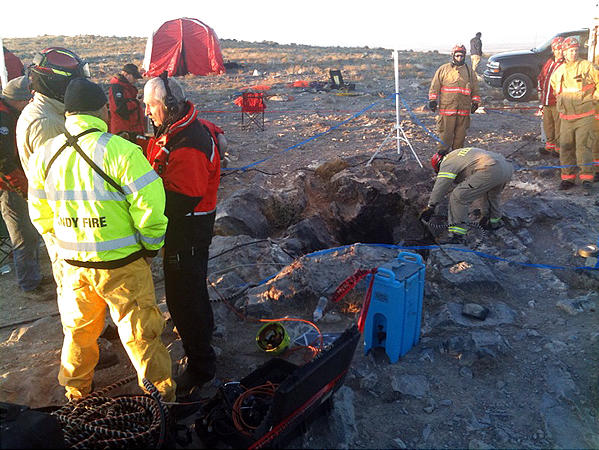

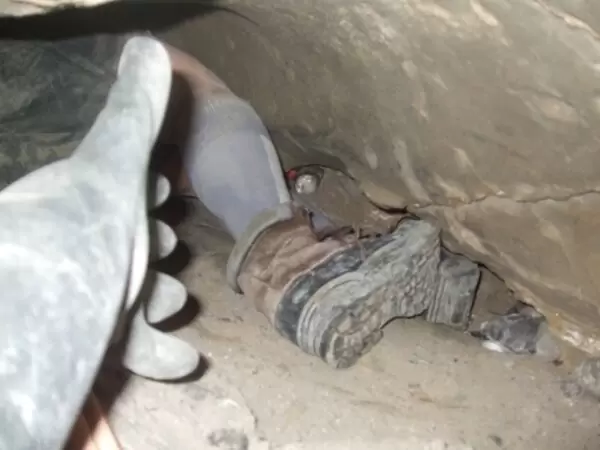
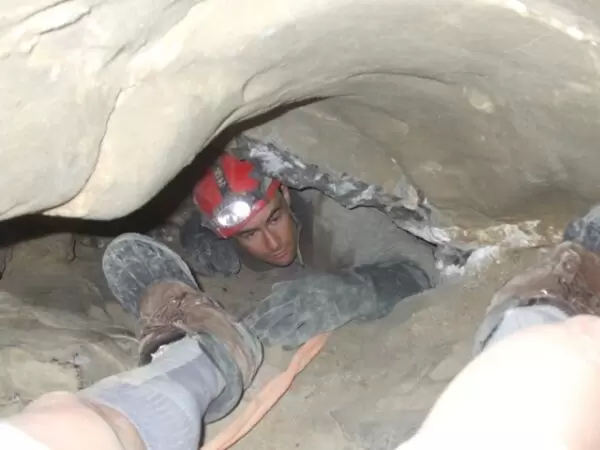
NOTES
- The 4 to 1 haul didn’t work because there were so many twists and turns in the cave between where there was room for a group to stand and haul and John’s position that the friction, even with pulleys in place was enough to render the haul system ineffective.
- This was the moment he passed away.
- Ultimately it was decided it would be too risky to rescuers to attempt to remove the body, and to this day Nutty Putty Cave is the final resting place of John Jones.
RESOURCES
VIDEOS

COMMENTS
Comment about Comments Below
I really appreciate everyone’s kind and encouraging words in the comments below, as well as your questions. Unfortunately, I no longer have time to respond to questions and comments. I will continue to approve the comments you post as long as they are family friendly, but just know that I only log in to approve comments every few weeks.
Thanks again for your kind words!
Thank you for this write-up, for answering all these questions and for being in such a courageous line of work as rescue when called upon.
Re: Ed’s Push
Any idea who “Ed” was? I’m guessing the first person to examine that passage, so he got to have it named after him?
Hello Brandon,
Thank you for sharing this unique experience with everybody
Can you please answer the following two questions?
1. When a rope has multiple friction points as it passes through a tight, twisting cave environment, the cumulative friction can create significant resistance to movement. However, if the rope is strong enough, the main challenge may shift to generating sufficient pulling force to overcome this friction. Given this, why did the rescue team in Nutty Putty Cave spend a significant amount of time installing a pulley system, when a simpler approach using a stronger rope or multiple ropes, combined with a powerful pulling mechanism (e.g. a car or truck), could have been more effective in generating the necessary force to extract John Jones?
2. Attaching the rope to his foot created a lot of resistance and made it difficult to maneuver his body. Securing the rope to his hands or wrists could have opened up more options for moving his body during the extraction effort. So why was John Jones’ foot attached to the rescue rope instead of his hands or wrists during the Nutty Putty Cave rescue attempt?
Thank you !
Hi Brandon,
thank you for your patience answering all the detailed questions. I got really good insights from the rescue procedure!
I got a couple more and sorry if you already answered them:
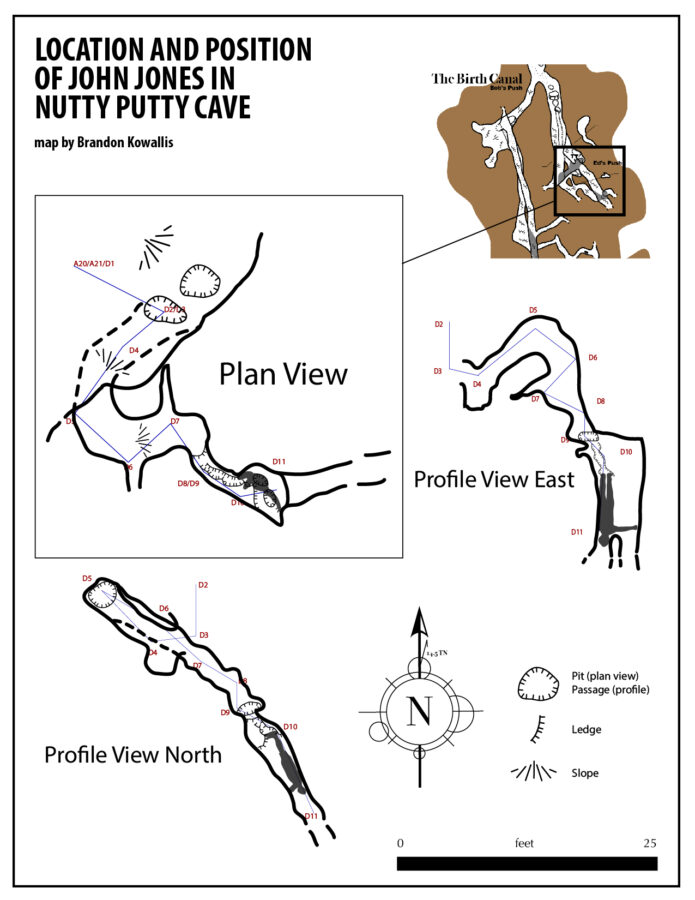
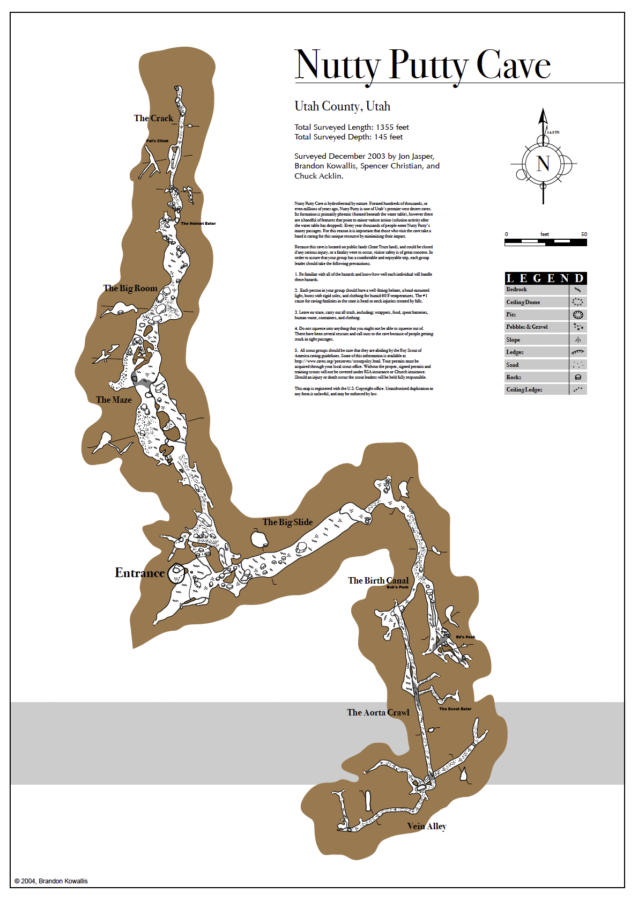
Could you please elaborate more on the Profile East and North in your illustrations? I am not an expert on cave map readings, but i dont get why John was really stuck? What prevented him from moving on?
From your illustrations it seems that he could turned himself, if not from upside-down to upward position, but at least rotating around his own axis?
Was the spot he was trapped the mentioned 18 inch x 10 inch chamber or did it widen up towards his head?
I wonder why he could not push it further down the “uncharted” area, i dont say this would have been a good idea, but under those circumstances maybe another attempt to find a room which widens up.
Thank you!
Hi Brandon,
thank you for your patience answering all the detailed questions.
I got really good insights from the rescue procedure! I got a couple more and sorry if you already answered them:
Could you please elaborate more on the Profile East and North in your illustrations?
I am not an expert on cave map readings, but i dont get why John was really stuck?
What prevented him from moving on? From your illustrations it seems that he could turned himself, if not from upside-down to upward position, but at least rotating around his own axis?
Was the spot he was trapped the mentioned 18 inch x 10 inch chamber or did it widen up towards his head?
I wonder why he could not push it further down the “uncharted” area, i dont say this would have been a good idea, but under those circumstances maybe another attempt to find a room which widens up.
Thank you!
Thank You so much Brandon for the insight and replies. Your perspective is helping me significantly process this horrific accident. I watched one of the documentary videos the past Sunday night and I am still waking up at 3 a.m. running through anxiety filled scenarios around why this happened so quickly and easily. (Yeah it’s my analytical brain getting hung up in an OCD loop along with some moderate claustrophobia to keep me awake). Where’s that valium when you need it? Again, Thank You. Your replies are helping me process as it seems there was just no viable solution to save John from is own inexperience. One question I seem to dwell on is whether or not there is any kind of warning difficulty standard or “weight height” specification posted on a cave entrance, and/or the maps? (Although I acknowledge selecting the wrong cave would have negated any difficulty or size specification on a map). Clearly John was too large for this cave. It is my understanding, due to his size, he could not turn around past Ed’s push which led him to keep going forward head first to find a more open area to make the turn. Were you and the other uber brave rescuers able to make the turn and exit the cave head first back through Ed’s push? If yes, I’m guessing this is due to a combination of smaller more fit body composition and of course skill. Thank you for this blog, and for your focus on rescuing folks from these terrible situations.
Anything is possible.
I took pictures of John’s position in the cave using one of search and rescue’s cameras. It was their call which photos were released to the media. Generally pictures of a body are not shared over the news media for various legitimate reasons.
Good questions.
1. It can be challenging for anyone to look at a cave map and associate the actual passage with what is on the map. I would guess that most people who went in Nutty Putty never even used a map. They would have gone off of what other’s told them, which may or may not have been accurate. So I can see where confusion would arise.
2. Yes. there was enough space to turn around, but it would require enormous upper body strength and flexibility to do that, which John (and most people for that matter) didn’t have and so he was dependent on others finding a way to help him compensate for that, which given the nature of the cave and his position was pretty much impossible. And yes, it only sloped steeply down in the area he was stuck.
3. Yes it did. But no one really dug into the facts. News is always just looking for a good story and so they will grab onto the most interesting “fact” without bothering to check it. Most of the time legitimate news outlets like Associate Press, Reuters, BBC and NPR are 80-90% accurate, but when they are trying to compete for peoples’ attention as quickly as possible they can’t check everything.
No idea and Dale Green who mapped it the first time round died several years ago.
1. I can only speculate here. You would need several hundred feet of rope to reach from where John was to a vehicle outside the cave which would result in dozens if not hundreds of friction points. If you were then using a vehicle to pull him there would be a significant risk in exerting too much force which could seriously injuring John. There is a fair amount of stretch in a rope and if it recoiled during the process I would imagine he could have gotten forcibly pulled through the cave and torn to pieces in the process.
2. I wasn’t there when they tied the rope to him so I’m not sure what they were up against in making that decision. It could have been that they just couldn’t reach his hands well enough to secure the rope, or maybe his position and the nature of the passage eliminated that as an option, or it could have been that the rope would have been more secure tied to ankles than wrists. Who knows.
The profile view is a side view of the passage. I drew one as though you were looking at it from the west to the east and the other as though you were looking from the south to the north. The illustration was based on memory so it is not exact. Most of the illustrations and videos you see make it look like it would be easy to get him out, but the reality when you are in there is much different and it would differ depending on the person and their abilities. You could have two people stuck in a passage and one wiggles and strong arms their way out without too much problem, while the other because of their physique and abilities remains hopelessly stuck.
18 inches is an average. Passages in caves very even within a few feet. In some places it was 18 in others it was more like 10.
I’m not sure we’ll ever know why he did nor didn’t do the things he did and didn’t do.
There was not. I know of several wild gated caves that have different warnings and those signs are often either shot up or ignored. I’ve run into plenty of people that are woefully underprepared despite any signage or information online about how to safely navigate caves.
I think I probably could have gotten myself out if I were stuck in the same place, but it would not have been easy, and like you said I am much smaller, more fit, and more experienced than John was.
I am so sorry you had to experience this. Thank you for writing it up. The report mentioned John was talking about seeing angels and demons. Can you go into specifics about what you heard?
A dreadful death but also a preventable one. Why on earth would someone squeeze into something like that without knowing where they will end up? Madness.
And putting so many other people at risk. All the rescuers involved were so brave. What an awful situation to have to work in.
Thank god its sealed up now.
Thank you all for your efforts and bravery.
Why resquers don’t try to destroy the cave to save John , explain me briefly because I am unknown about cave exploring
Hey Brandon,
I too must have been hit by this going viral. I hadn’t heard about this before, and a YouTube video showed up on my feed detailing the incident.
First of all, I’d like to say I’m so sorry to John’s family, and I hope that they’ve found peace and closure. Secondly, I’d like to thank you and all of the other rescuers involved as you are all heroes in my book. I am claustrophobic, and can’t imagine imagine what it would take to do what you do.
I have an odd question that I don’t think has been asked:
If you had been stuck in the same position that John was head first, could you have escaped? From everything I’ve read, you are in excellent physical condition, a bit smaller, and have a tremendous amount of experience.
I know you mentioned Dale possibly escaping from not as far in, but I’m just curious if an expert in great shape with a smallr frame could have escaped that predicament.
Thanks again for everything.
Hey Brandon,
Thanks for the write up, that was really informative. I really wonder in this case if there is even any rescue method that was possible to safe John’s life. Hypothetically say all equipments are available within 2 to 3 hours of John being stuck and everybody is fresh and ready. What kind of operation would be possible to get him out as fast as possible before time runs out ?
I was thinking a thick steelwire connected to a heavy truck with a lot of torque to overcome the friction from the twist and turns. This in turn is connected to a anchored/bolted down differential to at the mouth of the birth canal to stabilize and convert the insane tension from the truck. The torque from the truck will turn a geared down winch with steel wire that go all the way to John. This will elimate the time needed to install the pulleys and hopefully have enough torque to overcome the friction to navigate through the twist and turn of the cave.
I can see a few potential problem like the differential mechanism probably didnt exist or strong enough to handle the sudden tension load when the constant friction-snap. Not to mention no anchor that can be made with hand will be strong enough.
Hi Mr. Kowallis,
Firstly, thank you for sharing this story. I just have one question about your map of the area where Mr. Jones was stuck, particularly stations D9, D10, and D11. For D9 it looks like it’s the very tight opening that makes the sharp turn which opens up into the smaller area where John’s feet were. But from Stations D10 to D11, on the Profile View East, it appears to be a narrow but wide rectangular area in which John was stuck at the bottom left part of the room. It looks like once you make the squeeze at D9, you simply fall right into the D10 room straight down to D11. So the area where John was stuck is pretty wide, where more that one person can squeeze in as well?
I only ask because a lot of these YouTube videos (too many) make the passage appear as narrow and wide as a small tube with absolutely no room to move even one arm.
Thank you for your time.
Hi Brandon,
Thank you so much for this blog post, this forum, and your bravery around the whole story. It’s truly astonishing. There’s so much on this page that clarifies and firms up a lot of misinformation that is being carried into a lot of recent viral videos: that Brock Clark was trapped in the same place; that nobody had been to where John was; as well as the general feeling/shape of the area where he was stuck, all of which I think has the unfortunate effect of distorting the realities of the situation.
The biggest takeaway I suppose I have is that I get the feeling very few people who are confounded by what happened, have any experience being in those sorts of environments/cave passages. It just feels unfathomable. Myself included.
I suppose the main questions I have that still confuse me are:
1) When someone is pushing themselves into a tight space like that, especially head first, I feel that for myself I wouldn’t be able to get further than half a body length, before panic about getting stuck or to a point of no rescue/return would set in. What would compel someone in John’s situation to keep pushing and pushing and pushing further into the problem? It feels like there were so many “opportunities” where he’d already gotten stuck or gone beyond the point of comfort, it’s just impossible to believe that he wouldn’t stop and call for help way earlier? My understanding is he was multiple body lengths into extremely tight passages. How does that happen? Is there a lack of oxygen or something in the caves that could account for why someone would start to respond like that even when panicked? Similar to people who try to swim against currents and drown themselves?
2) It seems clear that there were multiple perceptions around what “Nutty Putty” was. Some cavers say it was a beginners cave, while others say there are numerous places that were well beyond the scope of what the average non-caver would consider a “beginner”. There’s hundreds of stories of people getting stuck, in similar places, for hours, and getting themselves out, etc, while some of the YouTube videos of the long and tight Aorta Crawl etc, look well beyond the scope of what someone like myself, with no experience, would consider beginner. To me a beginner cave is a wide open space that you walk around with the occasional bat flying past. Do you think there was a miscommunication around the nuances of how difficult a cave Nutty Putty was? And that some referred to the more open chambers as beginner, which got conflated with the more difficult areas? And what some folks might have meant as “a good cave to TEACH beginners” got mistaken for “anyone can do this” type of thing? It feels like there are numerous places that could/should’ve been marked with “do not go here alone” while other more open spaces could’ve just been for the broader public.
3) In considering the attempts and methods to get John out, a couple questions: a) Given John’s situation it seems a lot of precious time was lost simply getting in and out of the caves and getting help, or working out what to do between each rescue attempt, and that after the first 12 hours or so, his chances of survival diminished rapidly. In this type of situation, would you say there is an urgency in frontloading the initial efforts with the best, harshest, strongest attempts possible, instead of slowly escalating the effort over time? It feels like Josh’s initial attempts to pull him out, followed by the pulley system, were the first and last chances he had to get out, after which the success rate diminished to near zero. Would you say that a higher stakes effort places on those initial attempts might’ve yielded better results? Say immediately starting with the pulleys. Communicating to John that it was now or never as it would get more difficult over time? and b) given the excruciating pain he was in, was medical intervention ever considered? Say he was pumped full of painkillers or adrenaline or something of a numbing/activating nature. Could that not have helped the initial attempts while he was still conscious?
Thanks so much for your time and work in this case and in the caving community. It’s truly one of the most mind blowing and alarming deaths and situations I’ve ever heard of in my whole life that defies so many of my natural instincts about humans. I’m a skydiver, and compared to this, the risk/fear factor seems near zero!
I appreciate your thoughts helping shine light on it all and set the misinformation/records straight.
Best,
Steven
Thank you for the detailed explanation. In the satellite imagery on Google Maps, I can see a distinctive “mound” or “stone piles”, to the 160ft east of the sealed cave entrance, but is this some sort of memorial or map marker related to the accident, or just a natural feature? From the time comparison, it appears to have been created between 2011 and 2013.
I read somewhere that they lifted John 10 feet or so out of the cave and then a pulley broke and he slid back into the hole. Is this true? Would they have been able to get him out if the pulley hadn’t failed? Or is this a false detail.
I’ve read about this before, but never your perspective. Thank you for your hard work trying to save him. I’m sad for you that you were by him when he passed, but maybe on some level he knew you were there too? Idk but I’d rather die with someone than alone.
Take care!
Hello from Brazil, Brandon
Thank you for your testimony
I’m curious to know, what is the story/meaning behind the “Ed’s push” name?
Wow Brandon. What a tough and admirable job you have. Thank you for sharing your story, as only those who were there can really understand the conditions. Even though you described how tight and small the passage is, the pictures really illustrate the near impossible task the rescue team faced.